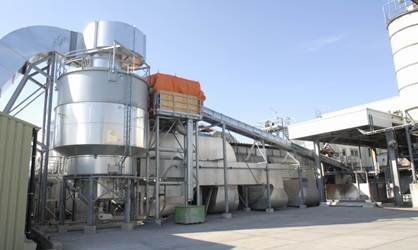
The first large-scale TORBED dryer system was installed in 2004 and has run successfully ever since.
- Drying is typically a low temperature process.
- It can be a first stage in preparing biomass for transportation or for further processing.
- TORBED dryers have:
- a much smaller footprint than conventional Industrial Belt dryers or rotary drum dryers.
- the ability to utilize waste heat from another process, thereby enhancing efficiency
- the ability to process fine particles that can create dust control problems with other technologies.
- The plant shown in the picture is used to dry wastepaper sludge, which is then sold for use as animal bedding. A practical recycle for a waste that would otherwise decay producing methane. A three stage TORBED dryer is in the foreground: the belt dryer it replaced remains in situ.
- The belt dryer, now decommissioned, used more energy, had higher operational costs and produced less output. The TORBED can be run remotely whilst the belt dryer required a team 24/7.
- The feed is ~5 t/h paper sludge at up to 65% water
- The drier uses 3 stages in series within the single structure to produce an output with ~5% water, removing just over 3 tonnes of water per hour.